What temperature range can MIL-W-22759 aviation cable withstand
In the aviation and aerospace industries, where environmental conditions are extremely harsh and safety requirements are paramount, the performance of electrical components directly determines the reliability of the entire system. Among these components, MIL-W-22759 aviation cable stands out as a critical link in power transmission and signal communication, thanks to its exceptional resistance to extreme temperatures, corrosion, and mechanical stress. For engineers, procurement specialists, and maintenance teams involved in aviation projects, understanding the temperature range that MIL-W-22759 aviation cable can withstand is not only a basic requirement for product selection but also a key factor in ensuring operational safety and longevity. This article will delve into the temperature tolerance characteristics of MIL-W-22759 aviation cable, explore the factors influencing its temperature resistance, and analyze its performance in different application scenarios.
The Basic Temperature Range of MIL-W-22759 Aviation Cable: A General Overview
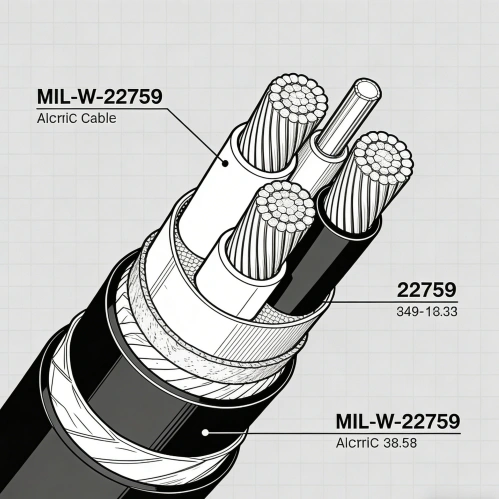
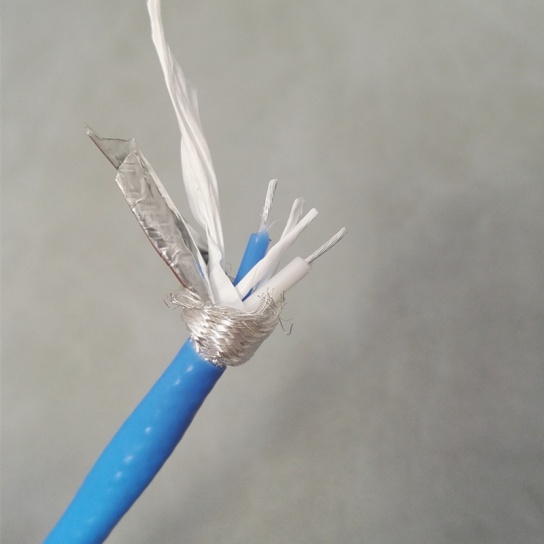
MIL-W-22759 is a military standard for aviation wires and cables, which specifies strict requirements for their structure, materials, and performance to meet the demanding needs of aerospace and military applications. When it comes to temperature resistance, the core determinant is the insulation material used in the cable, as the conductor (typically copper-based) has relatively stable performance across a wide temperature range. Generally speaking, most MIL-W-22759 aviation cables feature Polytetrafluoroethylene (PTFE) or modified PTFE derivatives as insulation materials, which endow them with excellent high and low temperature resistance.
According to industry standards and product specifications, the standard long-term operating temperature range of MIL-W-22759 aviation cable with PTFE insulation is from -190°C to +260°C . This means that the cable can maintain its electrical insulation properties, mechanical strength, and structural integrity when operating continuously within this temperature range. What is even more remarkable is that PTFE-insulated MIL-W-22759 cables can withstand short-term high temperatures of up to 300°C without significant degradation of performance . This short-term high-temperature tolerance is particularly valuable in scenarios such as welding operations near the cable or temporary temperature spikes in aircraft engines, where the cable needs to resist sudden thermal shocks.
It is important to note that while the general temperature range provides a baseline, specific models of MIL-W-22759 cables may have slight variations in temperature resistance due to differences in insulation thickness, conductor plating, and modified insulation materials. For example, some models using FEP (Fluorinated Ethylene Propylene) insulation or XLETFE (cross-linked ethylene tetrafluoroethylene) insulation have a long-term operating temperature rating of 200°C, with a low-temperature tolerance of -65°C . These variations are designed to meet the specific needs of different application environments, such as weight-sensitive instrument systems or low-temperature aerospace missions.
Why Can MIL-W-22759 Aviation Cable Withstand Extreme Temperatures? The Role of Insulation Materials
The exceptional temperature resistance of MIL-W-22759 aviation cable is largely attributed to the superior properties of its insulation materials. PTFE, the most commonly used insulation material for this series of cables, is a synthetic fluoropolymer with unique chemical and physical characteristics that make it ideal for extreme temperature environments.
At high temperatures, PTFE exhibits remarkable thermal stability. Unlike traditional insulation materials such as PVC, which soften, melt, or decompose at temperatures above 100°C, PTFE has a melting point of approximately 327°C and can maintain its structural stability even at 260°C for long periods . This is because the carbon-fluorine bonds in PTFE are extremely strong, making it resistant to thermal decomposition and oxidation. Additionally, PTFE is inherently flame-retardant; it does not burn when exposed to open flames and will self-extinguish once the flame is removed, which is a crucial safety feature in aviation applications where fire hazards are a major concern .
In low-temperature environments, PTFE also performs exceptionally well. Most insulation materials become brittle and prone to cracking at low temperatures, which can lead to insulation failure and short circuits. However, PTFE remains flexible even at -190°C, the temperature of liquid nitrogen, without losing its mechanical strength or insulation properties . This low-temperature flexibility ensures that MIL-W-22759 cables can operate reliably in high-altitude aerospace environments, where temperatures can drop to extremely low levels, or in military applications in cold regions.
For modified insulation materials used in some MIL-W-22759 models, such as XLETFE, their temperature resistance is optimized for specific scenarios. XLETFE, a cross-linked variant of PTFE, has a long-term operating temperature of 200°C and maintains excellent mechanical properties after aging at 180°C for 168 hours, with a tensile strength retention rate of over 85% and an elongation at break retention rate of over 75% . This makes it suitable for applications that require long-term stability at moderately high temperatures, such as military vehicle electrical systems and naval ship equipment.
Temperature Resistance Variations Among Different MIL-W-22759 Models
The MIL-W-22759 standard covers a wide range of cable models, each designed for specific applications and thus having different temperature resistance characteristics. Understanding these variations is essential for selecting the right cable for a particular project. Below are some common models and their temperature range specifications:
MIL-W-22759/9 and MIL-W-22759/10: These models use PTFE extrusion insulation and are widely used in aircraft engines and instrument systems where space is limited and weight is critical . Their long-term operating temperature range is -190°C to 260°C, with short-term high-temperature resistance up to 300°C. The PTFE insulation effectively resists the high temperatures generated during welding processes, preventing insulation shrinkage or melting .
MIL-W-22759/34: This model features a lightweight design, making it suitable for military aircraft, helicopters, and spacecraft communication systems . It uses PTFE insulation but has a slightly different temperature rating, with a long-term operating range of -65°C to 200°C and a rated voltage of 600V. Its temperature resistance is balanced with weight reduction, meeting the needs of weight-sensitive aerospace applications.
MIL-W-22759/41: Equipped with XLETFE insulation and nickel-plated copper conductors, this model is primarily used in defense applications . It has a long-term operating temperature of 200°C and can withstand low temperatures of -65°C without surface cracking. After aging at 180°C for 168 hours, its mechanical properties remain excellent, ensuring reliable performance in long-term high-temperature environments.
MIL-W-22759/111: This model uses PTFE insulation and silver-plated copper conductors, offering superior electrical conductivity and radiation resistance . Its temperature resistance aligns with the standard PTFE-insulated models, ranging from -190°C to 260°C, and it complies with RoHS/REACH environmental standards, making it suitable for modern aerospace and defense projects with strict environmental requirements.
Factors Affecting the Temperature Resistance of MIL-W-22759 Aviation Cable
While MIL-W-22759 aviation cable is designed to withstand extreme temperatures, its actual performance in service can be influenced by several factors. Engineers and maintenance personnel must consider these factors to ensure the cable operates within its safe temperature range.
1. Insulation Thickness and Type
The thickness of the insulation layer directly affects the cable’s heat dissipation and thermal resistance. MIL-W-22759 cables are available in thin-walled, medium-walled, and thick-walled versions, corresponding to operating voltages of 250V, 600V, and 1000V respectively . Thick-walled insulation provides better thermal insulation and can withstand higher temperatures for longer periods, but it also increases the cable’s weight and diameter. In contrast, thin-walled insulation is lighter and more suitable for tight spaces but may have slightly lower long-term high-temperature resistance.
Additionally, the type of insulation material (PTFE, FEP, XLETFE, etc.) determines the baseline temperature resistance. PTFE offers the widest temperature range, while FEP and XLETFE are optimized for specific temperature and mechanical requirements.
2. Conductor Plating and Material
MIL-W-22759 cables typically use copper conductors with plating options such as silver, nickel, or tin . While the conductor itself has good thermal conductivity, the plating material can affect its resistance to high temperatures and corrosion. For example, silver-plated conductors have excellent electrical conductivity and can withstand high temperatures up to 260°C, making them suitable for high-frequency signal transmission in high-temperature environments . Nickel-plated conductors, on the other hand, offer superior corrosion resistance and can maintain performance at 200°C, making them ideal for marine and harsh chemical environments .
3. Environmental Factors
In addition to temperature, other environmental factors can also impact the cable’s temperature resistance. For instance, exposure to chemicals such as strong acids, alkalis, or solvents can degrade the insulation material, reducing its thermal stability . Fortunately, PTFE insulation is highly resistant to almost all chemicals except molten alkali metals, ensuring stable performance in corrosive environments . Humidity and ultraviolet (UV) radiation can also affect insulation aging; however, PTFE is non-hygroscopic and UV-stable, making it suitable for outdoor and high-humidity applications .
Mechanical stress, such as vibration and bending, can exacerbate the impact of extreme temperatures on the cable. In aviation applications, where aircraft are subject to constant vibration during flight, the combination of mechanical stress and high/low temperatures can accelerate insulation fatigue. MIL-W-22759 cables are designed to withstand such conditions, with excellent mechanical strength and flexibility to ensure long-term reliability .
Application Scenarios: How MIL-W-22759 Cable Performs in Extreme Temperature Environments
The exceptional temperature resistance of MIL-W-22759 aviation cable makes it suitable for a wide range of high-demand applications in aviation, aerospace, and defense. Below are some typical scenarios where its temperature tolerance plays a critical role:
1. Aircraft Engine Compartments
Aircraft engine compartments are among the harshest environments for electrical cables, with temperatures often exceeding 200°C during operation and occasional spikes up to 300°C. MIL-W-22759 cables with PTFE insulation are widely used here due to their ability to withstand continuous high temperatures and short-term thermal shocks . They ensure reliable power transmission to engine control systems, sensors, and actuators, even in the presence of vibration and engine exhaust heat.
2. Aerospace and Satellite Systems
In space, temperatures can vary drastically from -190°C in shadowed areas to 200°C in direct sunlight. MIL-W-22759 cables with PTFE insulation are ideal for satellite communication systems, navigation equipment, and spacecraft power distribution due to their wide temperature range . Their low-temperature flexibility prevents insulation cracking in the extreme cold of space, while their high-temperature resistance ensures performance in direct solar radiation.
3. Military Vehicles and Naval Ships
Military vehicles operating in desert regions may face ambient temperatures exceeding 50°C, with engine compartment temperatures even higher. Naval ships, on the other hand, are exposed to high humidity, saltwater corrosion, and occasional low temperatures in polar regions. MIL-W-22759 models such as /34 and /41 are designed for these environments, with temperature ranges of -65°C to 200°C and excellent corrosion resistance . They ensure reliable electrical performance in communication systems, weapon control units, and power distribution networks.
4. Welding and Industrial Aviation Maintenance
During aircraft maintenance, welding operations near electrical cables are common. The high temperatures generated by welding torches can easily damage conventional cables, but MIL-W-22759 cables with PTFE insulation can resist the heat from welding, preventing insulation shrinkage or melting . This makes them a preferred choice for wiring in areas that may be exposed to welding activities, ensuring maintenance safety and reducing the risk of cable failure.
Key Considerations for Selecting MIL-W-22759 Cable Based on Temperature Requirements
When selecting MIL-W-22759 aviation cable for a specific project, it is crucial to match the cable’s temperature rating with the actual operating environment. Here are some key considerations for engineers and procurement teams:
Define the long-term and short-term temperature ranges of the application environment. If the cable will be exposed to continuous high temperatures above 200°C, choose PTFE-insulated models with a 260°C rating. For applications with moderate temperatures (up to 200°C), XLETFE or FEP-insulated models may be more cost-effective.
Consider the impact of other environmental factors, such as chemicals, humidity, and vibration. Ensure the cable’s insulation material is resistant to the specific chemicals present in the environment and that its mechanical properties can withstand vibration and bending.
Check the cable’s voltage rating and insulation thickness. Higher voltage applications require thicker insulation, which may affect heat dissipation and temperature resistance. Balance voltage requirements with temperature and weight constraints.
Verify compliance with relevant standards. Ensure the selected MIL-W-22759 model meets military and aviation standards (such as SAE AS81044) and environmental regulations (such as RoHS/REACH) .
Conclusion
MIL-W-22759 aviation cable is renowned for its exceptional temperature resistance, which is a result of its high-quality insulation materials (primarily PTFE and its derivatives) and strict compliance with military standards. With a general long-term operating temperature range of -190°C to 260°C and short-term high-temperature resistance up to 300°C, it can meet the demanding requirements of aviation, aerospace, and defense applications. However, it is important to note that different models of MIL-W-22759 cables have varying temperature ratings due to differences in insulation materials and designs, so selecting the right model based on the specific application environment is critical.
By understanding the temperature range of MIL-W-22759 aviation cable, the factors influencing its temperature resistance, and its performance in different scenarios, engineers and maintenance teams can ensure the reliability and safety of electrical systems. Whether in aircraft engine compartments, space satellites, or military vehicles, MIL-W-22759 cable continues to be a trusted choice for extreme temperature environments, underscoring its irreplaceable role in the aviation and aerospace industries.
Premium Aviation Cables for Aircraft Systems: Elevating Safety and Performance
In the demanding world of aviation, reliability and precision are non-negotiable. Premium Aviation Cables for Aircraft Systems are engineered to meet the r.
When it comes to aviation safety and performance, every component must meet the highest standards—especially electrical systems. High-Temp Resistant Aviation Electrical Cables are engineered to deliver unparalleled durability and reliabi.
Designed to meet the rigorous demands of modern aviation and defense systems, Lightweight MIL-SPEC Aviation Wiring Cables represent the pinnacle of reliability, durability, and performance. Engineered to comply with stringent military sp.
From commercial airliners to military drones, aviation cables are the unsung heroes ensuring reliable power, data, and signal transmission in the skies. These specialized cables are engineered to withstand extreme conditions—think turbule.
Product Overview: aviation cable
Machine vision cables are specialized components designed to ensure high-speed, stable data transmission and signal integrity in automated imaging systems. Key features include:
Technical Specifica.