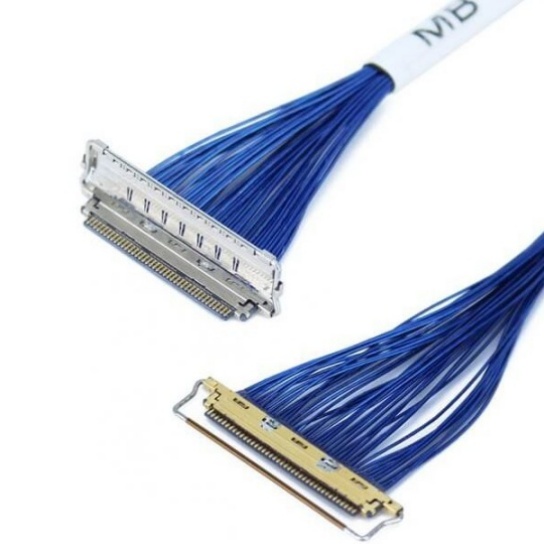
New Launch: High Temperature Aviation Micro Coaxial Cable (-55℃ to 260℃) Redefines Avionics Signal Transmiss...
Modern aircraft and spacecraft demand interconnects that are smaller, lighter, and more reliable than ever. The new generation of high temperature aviation micro coaxial cable, engineered for a -55℃ to 260℃ operating range, is built to meet this challenge. It is a critical enabler for next-generation avionics, where stable signal integrity must be maintained in extreme thermal and mechanical environments.
🎯 The Critical Need for -55℃ to 260℃ Performance
Aerospace systems operate in a harsh environment where a single point of failure can have severe consequences. The cable must perform reliably across a vast temperature range, from the frigid -55℃ of high-altitude flight or polar operations to the 260℃ heat found near engines, APUs, and braking systems.
Standard Performance:Many existing aerospace cables are rated for -65℃ to 200℃.
The New Standard:This new micro coaxial cable extends this range to 260℃, providing a crucial performance buffer. This is vital for applications near 200-230℃ zones and ensures greater reliability for future high-temperature systems and tighter design margins.
🔬 Engineering for Extreme Conditions
This cable is designed to excel where conventional cables fail. Its performance is a result of meticulous engineering at every layer.
Conductor: Silver-Plated Copper
The inner conductor is typically silver-plated copper. This combination provides high conductivity for minimal signal loss and a silver-plated surface that resists oxidation and maintains low contact resistance, even at 200-260℃.
Insulation: PTFE and Advanced Fluoropolymers
The dielectric is the core of the cable’s thermal performance. Options include:
PTFE (Teflon):Offers a long-term service temperature of 260℃ and a high maximum use temperature of 290-300℃.
PFA:Provides excellent mechanical toughness and a continuous use temperature of 260℃.
These materials ensure the cable remains dimensionally and electrically stable, preventing signal distortion from thermal expansion.
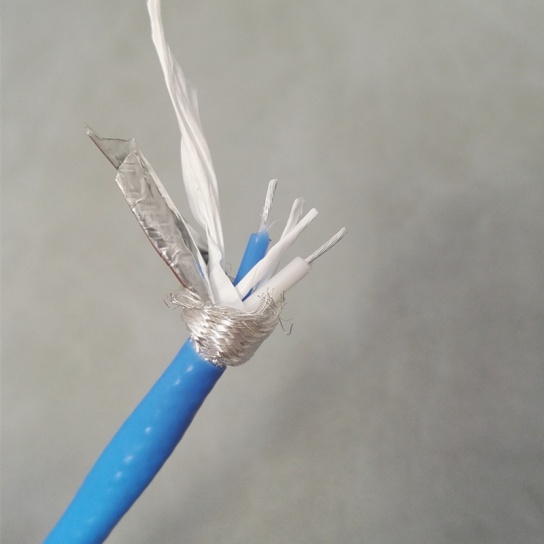
Shielding: Dual-Layer for Maximum EMI Protection
To combat electromagnetic interference (EMI) in densely packed avionics bays, the cable features a dual-layer shield:
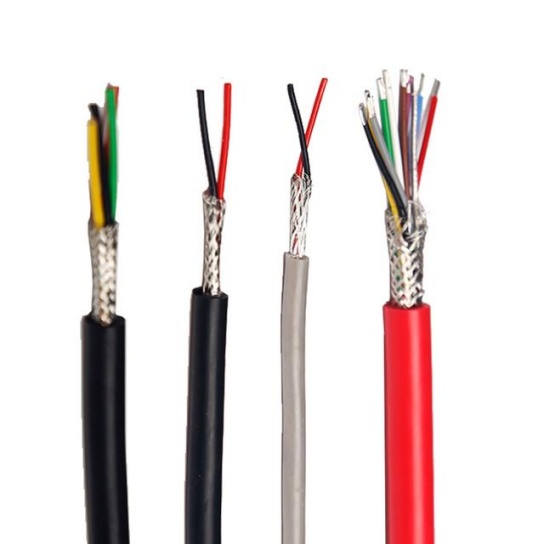
Outer Layer:A silver-plated copper braid offers 85-95% coverage, protecting against both high- and low-frequency noise.
This robust shielding is critical for protecting sensitive navigation, radar, and communication systems.
Jacket: Durable and Chemical Resistant
The outer jacket, made from materials like FEP or PFA, protects the core from moisture, fuels, and hydraulic fluids. It maintains flexibility at low temperatures and does not support combustion, meeting stringent aerospace flammability standards like FAR 25.853 and UL 94 V-0.
📊 Performance Comparison
This new cable pushes the boundaries of what is possible in aerospace micro coax design.
Feature
Standard Aerospace Coax
New High-Temp Micro Coax
Operating Temp.
-55℃ to 200℃
-55℃ to 260℃
Conductor
Silver-plated copper
Silver-plated copper (optimized)
Insulation
PTFE
PTFE / PFA
Shielding
Single or dual-layer
Enhanced dual-layer(tape + braid)
Voltage Rating
Typically 600V or 1000V RMS
Up to 1000V RMS
Frequency Range
Up to 12 GHz (typical)
Up to 12 GHz+
Weight & Bend Radius
Relatively larger
Smaller, more flexible
🚀 Key Applications
This cable is designed for critical systems where failure is not an option.
Radar & Altimeters:Ensures stable signal transmission for 4-12 GHz radars and 4 GHz radar altimeters, even with temperature swings and vibration.
Satcom & GPS:Maintains low-loss transmission for L-band and higher-frequency satellite communications in unpressurized areas.
Flight Control & Avionics Links:Connects high-speed data buses (ARINC 429, Ethernet) where phase stability and EMI immunity are paramount.
Engine Proximity & ECS:Performs reliably near engines, APUs, and environmental control systems where temperatures exceed 200℃.
Spacecraft & Reusable Launch Vehicles:Withstands the thermal cycling of launch, orbit, and re-entry, including exposure to atomic oxygen and vacuum.
✅ Design & Qualification Considerations
Selecting the right cable involves more than just the operating temperature.
Impedance Matching:For RF/microwave, a precise 50 Ω impedance is standard. Ensure the cable and connector are impedance-matched to minimize VSWR and signal reflections.
Phase Stability:For phased-array radar and navigation systems, cables must exhibit minimal phase change with temperature and flexure. Consult the manufacturer for phase-matched sets.
Flexibility vs. Shielding:Micro-coax offers excellent flexibility for tight spaces, but bend radius must be carefully managed to avoid increasing attenuation or damaging the shield.
Compliance & Traceability:Verify the cable meets relevant standards like MIL-DTL-17 or EN 4604 and is supplied with full material traceability and test reports.
💡 Conclusion
The new high temperature aviation micro coaxial cable (-55℃ to 260℃) is more than just a component; it is a critical enabler for the future of aerospace design. By combining extreme thermal performance, superior shielding, and a compact form factor, it empowers engineers to build lighter, more reliable, and higher-performing aircraft and spacecraft. When failure is not an option, specifying this grade of cable is a fundamental step toward mission success.
From commercial airliners to military drones, aviation cables are the unsung heroes ensuring reliable power, data, and signal transmission in the skies. These specialized cables are engineered to withstand extreme conditions—think turbule.
Designed to meet the rigorous demands of modern aviation and defense systems, Lightweight MIL-SPEC Aviation Wiring Cables represent the pinnacle of reliability, durability, and performance. Engineered to comply with stringent military sp.
Premium Aviation Cables for Aircraft Systems: Elevating Safety and Performance
In the demanding world of aviation, reliability and precision are non-negotiable. Premium Aviation Cables for Aircraft Systems are engineered to meet the r.
When it comes to aviation safety and performance, every component must meet the highest standards—especially electrical systems. High-Temp Resistant Aviation Electrical Cables are engineered to deliver unparalleled durability and reliabi.
Product Overview: aviation cable
Machine vision cables are specialized components designed to ensure high-speed, stable data transmission and signal integrity in automated imaging systems. Key features include:
Technical Specifica.