How Does Radiation Resistant Aviation Cable Withstand Extreme Space Radiation?
Radiation resistant aviation cable is the “nervous system” of aircraft and spacecraft, responsible for power distribution and signal transmission in environments where standard cables would fail. To function reliably, these cables must endure not only high and low temperatures, vibration, and vacuum, but also the constant bombardment of high-energy radiation in space. This article explores the nature of space radiation, the damage it inflicts on conventional materials, and the specific material, structural, and process-level strategies used to create cables that can withstand these extreme conditions for years or even decades.
Understanding the Space Radiation Environment
Space radiation is far more intense and complex than terrestrial radiation. It primarily consists of:
Trapped Protons & Electrons:Particles confined by Earth’s magnetic field, especially within the Van Allen belts, creating regions of high radiation flux.
Galactic Cosmic Rays (GCRs):High-energy nuclei from outside our solar system, producing secondary particles upon impact.
Solar Particle Events (SPEs):Bursts of high-energy protons ejected by the Sun during solar flares and coronal mass ejections.
Radiation Dose Levels:
Low Earth Orbit (LEO):~1–10 kGy (Si) total ionizing dose (TID) over a mission.
Geostationary Orbit (GEO):~10⁵ Gy (Si) TID over a 10–15 year design life.
Deep Space / Lunar Missions:Tens of kGy, plus a significant dose rate from GCRs.
Key Effects on Electronics:
Total Ionizing Dose (TID):Gradual accumulation of charge that degrades insulation and semiconductors, increasing leakage current and noise.
Displacement Damage:Lattice defects in materials that alter carrier mobility and lifetime, degrading performance.
Single Event Effects (SEEs):High-energy particles can cause bit flips, latch-up, or even permanent damage (SEB/SEGR) in electronics.
How Radiation Damages Conventional Cables
Radiation breaks the long polymer chains in insulating and jacketing materials through ionization and atomic displacement. This leads to:
Increased Conductivity & Permittivity:The material becomes “leaky,” causing higher leakage current, dielectric loss, and crosstalk.
Embrittlement & Microcracking:Cross-linking can make materials brittle, while chain scission leads to shrinkage and cracking, especially at bends or terminations.
Discoloration & Outgassing:Changes in optical properties and the release of volatile compounds can contaminate sensitive spacecraft optics and sensors.
Degradation of Shielding Effectiveness:Radiation can alter the conductivity and mechanical integrity of metal shields, reducing their ability to block electromagnetic interference (EMI).
Core Strategies for Radiation Resistance
Designing radiation-resistant aviation cable involves a multi-layered approach, combining advanced materials, smart construction, and rigorous processing.
1. Advanced Insulation & Jacket Materials
Material System
Key Properties & Performance
Typical Applications
Radiation-Crosslinked ETFE (X-ETFE)
High radiation resistance (5×10⁷ rad), wide temp range (-65℃ to 200℃), thin-walled (0.10-0.25 mm), meets MIL-W-22759.
High-density aerospace wiring, satellites.
Polyimide (PI) & PTFE
PI offers high TID tolerance and a wide temp range (-269℃ to 400℃). PTFE is chemically inert.
Satellites, spacecraft, atomic energy.
PEEK (Polyether Ether Ketone)
Exceptional TID tolerance (10⁷ Gy), high strength, and chemical resistance.
Demanding aerospace and nuclear applications.
Nanocomposite & Additive Systems
Inorganic fillers (e.g., nano-Mg(OH)₂, BaSO₄, La₂O₃) absorb energy, inhibit radical formation, and improve retention of mechanical/electrical properties after irradiation.
Next-gen deep-space cables.
2. Conductor & Shielding Design
Conductors:High-purity copper alloys (tinned, silver-plated, nickel-plated) are standard. Surface treatments like diamond-like carbon (DLC) coatings can further reduce radiation impact.
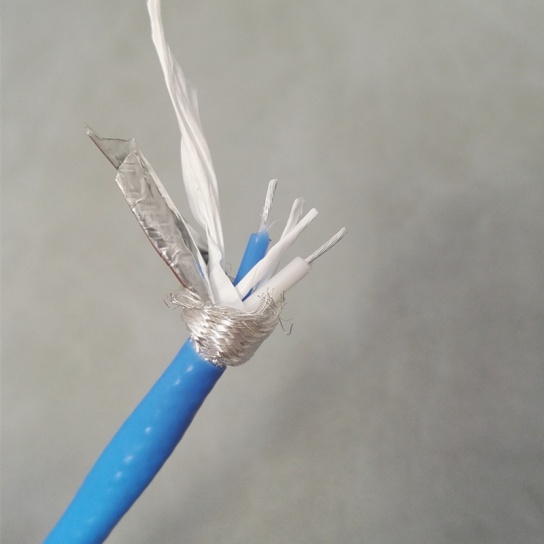
Shielding:Multi-layer shields (e.g., silver-plated copper braid + aluminum foil) provide high EMI protection. Radiation-hardened metal foils and conductive textiles are being developed to maintain shielding integrity.
3. Cable Architecture & Construction
Multi-Layer Insulation:Combining materials like PI and PTFE in layers provides synergistic benefits, allowing for thinner insulation and reduced weight.
Integrated / Triaxial Designs:Combining power, control, and RF signals into a single cable reduces weight, volume, and connector count, simplifying harnessing and improving reliability.
Redundancy:Using multi-core or redundant cables ensures system functionality even if one conductor is compromised by radiation or a SEE.
4. Manufacturing & Processing
Radiation Crosslinking:Using electron beams to create a 3D molecular network in polymers like ETFE, significantly enhancing their radiation and thermal resistance.
Post-Irradiation Treatment:A thermal “post-cure” step (e.g., 200±2℃) is used to remove harmful byproducts like hydrogen fluoride (HF) generated during irradiation, preserving the cable’s properties.
Performance Comparison: Standard vs. Radiation-Resistant
Feature
Standard Aircraft Cable
Radiation-Resistant Aviation Cable
Insulation Material
PVC, XLPE, standard PTFE
X-ETFE, PI, PEEK, nanocomposites
Radiation Tolerance (TID)
~10²–10³ Gy (Si)
10⁵–10⁷ Gy (Si)
Temp Range
-55℃ to 125℃
-65℃ to 200℃+
Weight & Size
Heavier, larger diameter
Lighter, smaller diameter (thin-walled)
Lifetime in Space
Months to a few years
10–15+ years
Standards
MIL-W-22759 (general)
MIL-W-22759 plus specific rad-hard specs
Real-World Applications
LEO Satellites:Use ETFE-insulated, lightweight cables designed for a 3-5 year life in a ~1-10 kGy environment.
GEO Satellites & Spacecraft:Employ high-TID materials like PI, PEEK, and X-ETFE for 10-15+ year missions, often exceeding 10⁵ Gy.
Manned Spacecraft:Combine radiation resistance with flame retardancy and low outgassing, using materials like modified PTFE and ETFE.
High-Altitude Aircraft:Cables in nuclear-powered aircraft or high-altitude testbeds must withstand intense, short-duration radiation pulses.
Testing & Qualification
Radiation-resistant cables undergo rigorous testing to ensure mission success:
TID Irradiation:Exposing samples to a controlled radiation dose and measuring changes in electrical properties.
SEE Testing:Using particle accelerators to simulate high-energy events and assess the risk of bit flips or latch-up.
Environmental Stress Screening:Combining radiation tests with thermal cycling, vibration, and vacuum exposure to simulate the full mission profile.
Future Trends
The future of radiation-resistant aviation cable points towards:
Multifunctional Materials:Combining radiation resistance with thermal management, self-healing, or sensing capabilities.
Advanced Nanocomposites:Using AI-guided material design to create custom compounds optimized for specific mission profiles.
Smart Cables:Embedding fiber Bragg gratings (FBGs) for real-time health monitoring of temperature, strain, and radiation dose.
Sustainable Manufacturing:Developing greener processes for producing high-performance, radiation-hardened materials.
From commercial airliners to military drones, aviation cables are the unsung heroes ensuring reliable power, data, and signal transmission in the skies. These specialized cables are engineered to withstand extreme conditions—think turbule.
Premium Aviation Cables for Aircraft Systems: Elevating Safety and Performance
In the demanding world of aviation, reliability and precision are non-negotiable. Premium Aviation Cables for Aircraft Systems are engineered to meet the r.
Designed to meet the rigorous demands of modern aviation and defense systems, Lightweight MIL-SPEC Aviation Wiring Cables represent the pinnacle of reliability, durability, and performance. Engineered to comply with stringent military sp.
When it comes to aviation safety and performance, every component must meet the highest standards—especially electrical systems. High-Temp Resistant Aviation Electrical Cables are engineered to deliver unparalleled durability and reliabi.
Product Overview: aviation cable
Machine vision cables are specialized components designed to ensure high-speed, stable data transmission and signal integrity in automated imaging systems. Key features include:
Technical Specifica.